Guide
Wood chip pile fire: why biomass piles self-heat and how to prevent it
7 min read

A wood chip pile fire usually starts inside the pile, not on its surface. Moist chips heat up through microbial activity and then chemical oxidation until the core can smoulder and ignite, sometimes weeks after the pile was built. The best protection is to store chips dry, in small, uncompacted piles for as short a time as possible, to monitor the temperature inside the pile and to detect smoke and fire gases early, especially when the site is closed.
Why wood chip piles self-heat
Fresh wood chips are not dead material. Living wood cells keep respiring for a while after chipping, and bacteria and fungi start to feed on the wood, especially on bark, needles and leaves, which are rich in nutrients. All of this releases heat. In a large pile the heat cannot escape quickly, because chips insulate well, so the temperature at the core keeps rising.
A practical note from COFORD, Ireland's forest research programme, describes the stages: bacteria first, then fungi up to about 45 °C, then heat-loving (thermophilic) fungi that take the pile to 70–80 °C. According to the same note, a pile with 45% moisture content and enough nutrients can reach 60–80 °C in as little as 24 hours, and the high temperatures can last for weeks.
At around 70–80 °C most microorganisms die, but the heating does not necessarily stop. A review in the journal Forests by Krigstin and colleagues explains that when temperatures exceed 80 °C, exothermic oxidation reactions contribute to self-heating and auto-ignition becomes possible. From that point the process is chemical: the wood itself reacts with oxygen, and if the heat keeps building, the core starts to char and smoulder.
The factors that raise the risk
- Moisture: wet chips heat fastest. COFORD advises never storing chips with more than 45% moisture for any length of time.
- Bark, needles and leaves: they feed microbes. Clean wood without bark heats very slowly or not at all.
- Pile size: a large pile generates more heat than it can lose through its surface. COFORD notes that self-igniting piles are typically very large, over 1,000 cubic metres of loose chips.
- Compaction: driving machines over a pile compacts it and traps heat.
- Storage time: the longer a pile sits, the more time the heating has to build up.
- Fines and foreign objects: fine particles self-heat more readily, and COFORD notes that a metal object is involved in almost all cases of self-ignition.
Wood chip pile fires in Latvia: two recent cases
In Latvia wood chips are a common fuel for heating boiler houses, and large stockpiles are often kept on open yards. Two fires in 2023 show how these piles behave once they catch fire.
In December 2023 a pile of fuel chips in the north of Rēzekne smouldered for almost a week. According to LSM, about 15,000 loose cubic metres of chips were stored on the site. The open flames had gone, but smoke kept rising over the district and the State Environmental Service reported that air pollution limits were exceeded downwind. The head of the local State Fire and Rescue Service (VUGD) unit said it was hard to predict how long it would take, because the smouldering spots inside the pile were very hard to reach. The company suggested sharp temperature changes as the cause; the article does not give a confirmed cause.
In September 2023 VUGD fought a fire on Uriekstes iela in Riga, between two chip piles where logs and wood shavings were stored. The burning area was about 250 m². Firefighters used the site's machinery to move the logs and reach the seat of the fire, and according to the VUGD report the work continued through the night into the next morning.
Both cases show the same pattern: once the inside of a large pile is burning, extinguishing it means digging it apart with machinery, which takes a long time and spreads smoke over the neighbourhood.
Warning signs of a wood chip pile fire
A self-heating pile gives signals well before it bursts into flame. Site staff should know them and have a clear action plan for each:
- Steam or vapour rising from one spot of the pile, especially on cold mornings, and snow melting on part of the pile.
- A smell of smoke, tar or burnt wood, or a sour, fermented smell that suddenly gets stronger.
- Rising temperature readings from probes, or a fast rise between two measurements.
- Dark, charred chips when the pile is opened, or a pile surface that sinks in one place.
- Thin smoke seeping out at the base or along the edge of the pile.
Fermenting chips also release gases. The Forests review notes that carbon monoxide and methane are produced as stored wood degrades, and that enclosed storage areas such as silos can become dangerous because of off-gassing and oxygen depletion. Never enter a closed chip store alone without ventilation and gas measurement.

Storage rules that prevent self-heating
There is no single EU rule for chip piles, but England's Environment Agency publishes detailed fire prevention guidance for permitted waste sites, which covers waste wood, including chips. Its limits are a useful benchmark for any wood yard:
| Rule | Environment Agency guidance (waste wood) |
|---|---|
| Maximum pile height | 4 m |
| Maximum length or width | 20 m |
| Maximum volume, particles under 30 mm | 300 m³ |
| Maximum volume, particles 30–150 mm or baled | 450 m³ |
| Maximum volume, pieces over 150 mm | 750 m³ |
| Separation from other piles, buildings and the site boundary | At least 6 m |
| Storage time | Less than 6 months; extra measures needed after 3 months |
| Fire response target | Aim to extinguish a fire within 4 hours |
For fuel chips, COFORD recommends a simple storage plan based on moisture content:
- Store chips dry. For storage longer than two to three weeks, keep the moisture content below 35%. Chips above 45% should be used within days to weeks.
- Keep piles small and regular, with no hollows where rainwater can collect.
- Do not compact piles and keep machines off the top where possible.
- Keep out needles, leaves and metal.
- First in, first used: rotate stock so that no part of the yard sits for months.
- Let freshly chipped material cool before adding it to a large pile, as the Environment Agency also advises.
Storing chips well also saves fuel value. COFORD estimates that normal forest chips stored above 35–40% moisture lose around 1% of their dry matter per month, and very wet, nutrient-rich chips more than 3%.
Monitoring: temperature probes, cameras and smoke sensors
The Environment Agency requires operators to monitor pile temperature with a probe or a similar device, to set temperature triggers and to turn piles routinely so the material stays cold. It also warns that surface measurements are unlikely to show the true temperature at the core, which is why probes pushed deep into the pile are the standard tool. Krigstin and colleagues tested wireless temperature sensors placed one metre below the top of real piles and argue that the industry needs better real-time monitoring.
Temperature probes show heating early, but only at the points where they are placed. A fire can also start from outside: a spark from machinery, hot ash, a discarded cigarette or a fire spreading from neighbouring land. For this reason the guidance also asks for a detection system that raises the alarm when the site is closed, such as smoke and heat detectors, flame-detecting cameras or infrared detection. Outdoor yards are hard to cover with indoor fire alarms, so the detection layer has to work in the open air, day and night.
Early detection for sawmills and biomass yards with SEBELO
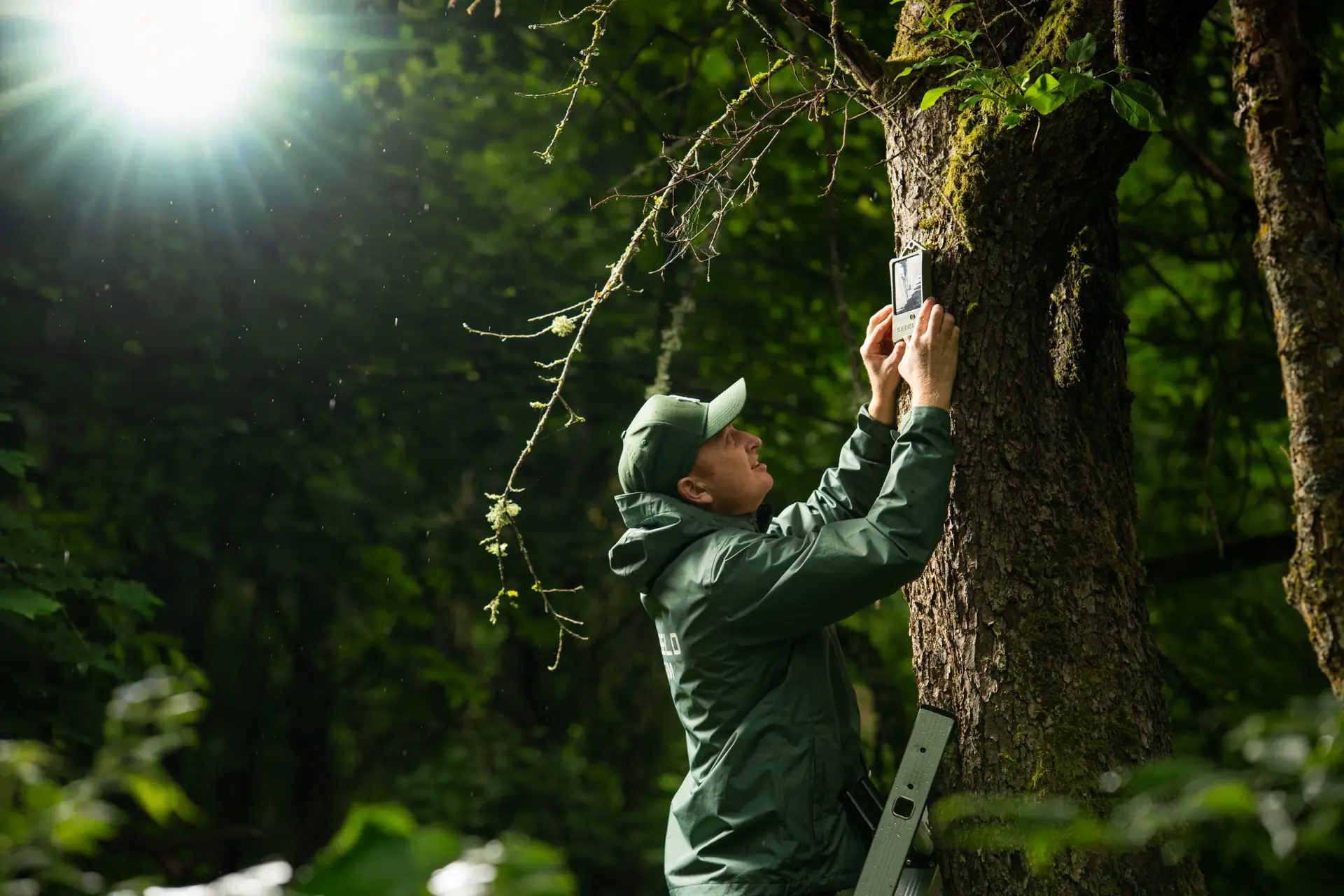
SEBELO's solar-powered sensors detect smoke and fire gases in the open air and send an alert as soon as they recognise the signature of a fire. Placed around chip piles, log yards and sawmill storage areas, they watch the site around the clock, including nights and weekends when nobody is there. Alerts appear on a live map in the cloud platform and go out by app, email and SMS, and an API lets the data flow into the operator's own systems. Read more about fire monitoring for industrial yards and open areas.
Sensors do not replace good storage practice or temperature probes inside the pile. They add a second layer that catches smoke and fire gases escaping from a smouldering pile, and fires that start outside it. Smouldering fires behave similarly in peat, where measuring fire gases close to the ground is one of the most promising ways to find hidden fires. The SEBELO sensor is still in development, with sales planned from early 2027.
Frequently asked questions
Can a pile of wood chips catch fire by itself?
Yes. Microbes and chemical oxidation heat the inside of a moist pile. Above about 80 °C oxidation can continue on its own and the core may smoulder and ignite. Self-ignition is most likely in large, wet, compacted piles with bark or needles that have been stored for a long time.
How hot does a wood chip pile get?
Biological heating typically takes a pile to 60–80 °C, and wet, nutrient-rich chips can get there within about a day. Microbes die off around 70–80 °C, but if heat cannot escape, chemical oxidation can push the core temperature higher until the wood chars, smoulders and eventually ignites.
How long can wood chips be stored safely?
It depends mainly on moisture. COFORD's guidance suggests that chips below 25% moisture can be stored for years, 26–35% for up to a year, 36–45% for months, and wetter chips only for days to weeks. England's Environment Agency limits combustible waste storage to under six months.
How do you put out a fire inside a wood chip pile?
Usually by digging the pile apart with machinery and cooling the burning material bit by bit, while moving unburnt chips away from the fire. Water sprayed on the surface rarely reaches the core. This can take days, which is why early detection and small, separated piles matter so much.
Sources
- Kofman — Health and safety aspects of using wood chips as a fuel (COFORD Connects, Processing/Products No. 41, 2016)
- Krigstin et al. — Recent Health and Safety Incident Trends Related to the Storage of Woody Biomass: A Need for Improved Monitoring Strategies (Forests, 2018)
- Environment Agency — Fire prevention plans: environmental permits (GOV.UK)
- LSM — Rēzekni pārņem dūmi – sesto diennakti gruzd šķeldas kaudze (6 December 2023)
- VUGD via LV portāls — Ugunsdzēsēji glābēji Rīgā jau gandrīz diennakti dzēš degošus kokmateriālus (21 September 2023)